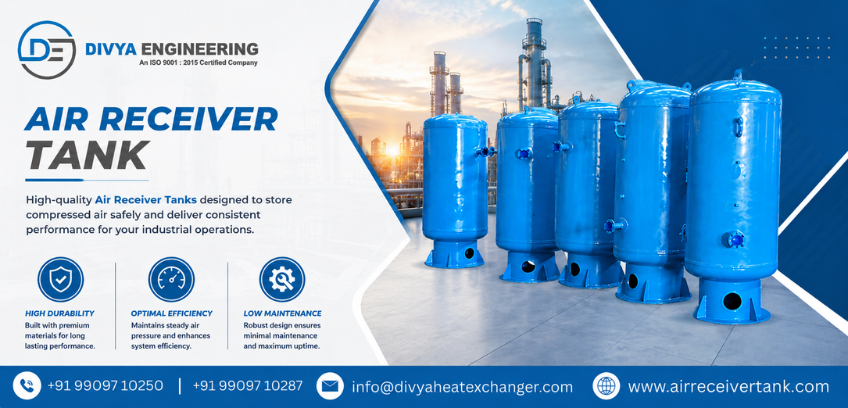
Air Receiver Tank Supplier for Textile Industry – Divya Engineers Private Limited
The textile industry depends on reliable compressed air for spinning, weaving, dyeing, finishing, pneumatic controls, instrumentation, and automated production equipment. When air demand changes throughout a production cycle, a properly selected receiver helps maintain a stable and dependable supply. Choosing an experienced Air Receiver Tank Supplier for Textile Industry can therefore make an important difference to plant efficiency, equipment performance, and operating reliability.
Divya Engineers Private Limited provides industrial pressure equipment and engineered air receiver solutions for different manufacturing requirements. With appropriate capacity, pressure rating, material, and configuration, an Air Receiver Tank can act as an effective buffer between the compressor and the textile production system.
Why Textile Mills Need an Air Receiver Tank Supplier for Textile Industry
Textile plants often operate multiple pneumatic machines simultaneously. Air consumption can change rapidly when different machines start, stop, or increase their demand. If the compressed air system cannot respond smoothly, pressure fluctuations may affect production equipment and product consistency.
An Air Receiver Tank Supplier for Textile Industry can help plants select a receiver based on compressor capacity, compressed-air consumption, operating pressure, peak demand, and installation conditions.
A receiver can provide several benefits:
Stores compressed air for temporary demand increases
Helps stabilize pressure within the compressed air network
Reduces frequent compressor loading and unloading
Supports smoother operation of pneumatic equipment
Provides a reserve of compressed air during short demand peaks
Helps improve overall compressed air system management
Provides an opportunity for moisture and condensate separation
The receiver should be correctly sized rather than selected simply according to compressor capacity.
What Makes the Best Air Receiver Tank Supplier for Textile Industry?
The Best Air Receiver Tank Supplier for Textile Industry should understand the practical requirements of textile manufacturing. A good supplier should provide more than a standard pressure vessel. It should offer technical guidance, appropriate material selection, customization, quality checks, and responsive customer support.
Application-Based Engineering
Textile plants have different air consumption patterns. Spinning mills, weaving units, processing plants, and textile machinery manufacturers may require different receiver capacities and configurations. A supplier should assess the complete system before recommending a solution.
Flexible Designs
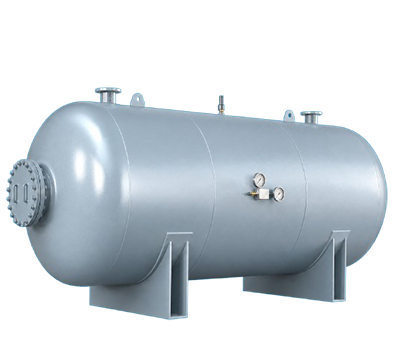
Depending on available floor space and plant layout, vertical or horizontal receiver arrangements can be considered. Nozzle positions, supports, drains, inspection openings, and connections may also be customized according to project requirements.
Strong Construction
The shell, dished ends, welded joints, supports, and connections should be fabricated with appropriate engineering practices. Material thickness and specifications should be selected according to design pressure and operating conditions.
Features of a Top Air Receiver Tank Supplier for Textile Industry
A Top Air Receiver Tank Supplier for Textile Industry focuses on durability, safety, and consistent manufacturing quality. Important features to evaluate include:
Robust fabrication: High-quality materials and controlled welding practices contribute to reliable service.
Suitable pressure rating: The receiver should be designed according to the required working and design pressures.
Industrial coating: Suitable surface preparation and protective coating can help protect the external surface from environmental conditions.
Safety accessories: Depending on the project, suitable safety valves, pressure gauges, drain arrangements, and inspection provisions can be incorporated.
Customized capacity: Receiver size should correspond with the compressor system, air demand, pressure requirements, and desired storage buffer.
Easy maintenance: Drainage arrangements and accessible inspection provisions can make routine maintenance more convenient.
Quality Standards and Manufacturing Approach
Quality is particularly important because an air receiver is a pressure-containing vessel. Customers should evaluate a manufacturer's experience with pressure equipment, material control, fabrication, welding, inspection, and testing.
Divya Engineers Private Limited manufactures industrial equipment with a focus on engineered fabrication and quality-oriented production. Its product portfolio includes Air Receivers and other pressure and heat-transfer equipment for industrial applications.
Before finalizing a receiver, buyers should discuss material specifications, design pressure, operating pressure, dimensions, testing requirements, fittings, surface treatment, and documentation. Applicable standards and certification requirements should be confirmed according to the specific project and installation location.
Buy Air Receiver Tank for Textile Industry – What Should You Check?
Before you Buy Air Receiver Tank for Textile Industry, collect the important technical information from your plant. This helps the manufacturer provide a suitable design and accurate quotation.
Consider the following:
Compressor capacity and airflow
Required receiver volume
Working and design pressure
Number of pneumatic machines
Peak compressed-air demand
Vertical or horizontal installation
Available installation space
Required inlet and outlet connections
Drain and safety arrangements
Coating and environmental requirements
Inspection and testing documentation
Buying based only on tank capacity can lead to an unsuitable selection. The receiver should work as part of the complete compressed air system.
Air Receiver Tank for Textile Industry Price – What Affects Cost?
The Air Receiver Tank for Textile Industry Price depends on several technical and commercial factors. Capacity, pressure rating, material thickness, tank dimensions, accessories, nozzle configuration, supports, coating, inspection, testing, and customization can all influence the final price.
Transportation and installation requirements may also affect the overall project cost. Therefore, textile manufacturers should compare complete technical quotations rather than choosing a supplier solely because of the lowest initial price.
A quality receiver can provide long-term value when it is correctly designed, manufactured, installed, and maintained.
Air Receiver Tank for Textile Industry Manufacturer and Export Capability
An experienced Air Receiver Tank for Textile Industry Manufacturer should have the capability to manufacture pressure vessels according to individual project requirements. Divya Engineers Private Limited serves industrial customers with engineered pressure equipment and air receiver solutions.
For overseas textile machinery and manufacturing projects, an Air Receiver Tank for Textile Industry Exporter should also be able to manage suitable documentation, packaging, shipment coordination, and destination-specific requirements.
Whether the requirement is for a textile mill, processing facility, spinning unit, weaving plant, or textile machinery installation, technical specifications should be finalized before manufacturing begins.
Top Cities of India We Serve
Divya Engineers Private Limited can support industrial customers across major textile and manufacturing markets in India, including Ahmedabad, Surat, Mumbai, Pune, Delhi, Bengaluru, Chennai, Hyderabad, Coimbatore, Kolkata, Jaipur, Vadodara, Rajkot, Nashik, Nagpur, Indore, Ludhiana, Panipat, Tiruppur, Salem, Erode, and Bhiwandi.
Textile businesses in these cities can discuss their compressor capacity, operating pressure, air consumption, receiver size, and installation requirements with the company to identify a suitable solution.
Maintenance Tips for Textile Air Receivers
Regular maintenance helps keep an air receiver reliable throughout its service life. Condensate should be drained appropriately, pressure gauges and safety devices should be checked, and the vessel should undergo required inspections according to applicable regulations and manufacturer recommendations.
Operators should also monitor corrosion, leakage, unusual pressure behavior, and the condition of external coatings. Any inspection or repair of pressure-containing components should be performed by appropriately qualified personnel.
FAQs
It provides stored compressed air and helps manage variations in demand, supporting more stable operation of pneumatic textile equipment.
Capacity depends on compressor output, air consumption, operating pressure, peak demand, and the desired buffer for the system.
Yes. Capacity, orientation, dimensions, connections, supports, coatings, and accessories can be customized according to project requirements.
Not necessarily. Oversizing can increase cost and installation requirements. Proper sizing according to the complete compressed air system is more important.
Provide the manufacturer with compressor details, required pressure, estimated air demand, capacity, installation orientation, and any special requirements.
Choose Divya Engineers Private Limited
If you are searching for an Air Receiver Tank Supplier for Textile Industry Near Me, Divya Engineers Private Limited can help you select an air receiver suited to your textile plant's operating requirements. From application understanding and engineering to fabrication and quality-focused manufacturing, the company provides industrial solutions designed around customer needs.
Contact Divya Engineers Private Limited today with your compressor capacity, pressure requirements, desired receiver volume, and installation details. Request a customized quotation and take the next step toward a stable, efficient, and dependable compressed air system for your textile operation.